Show One Sample Calculation to Find the Tf for a 52.0% Mass Solution (Again
Specific Heat Figurer
Created by Bogna Szyk
Reviewed by
Steven Wooding
Last updated:
Feb 15, 2022
- How to calculate specific heat
- Heat capacity formula
- Typical values of specific rut
- FAQ
This specific heat computer is a tool that determines the heat capacity of a heated or a cooled sample. Specific heat is the amount of thermal energy you need to supply to a sample weighing 1 kg to increase its temperature by 1 K. Read on to learn how to apply the estrus capacity formula correctly to obtain a valid effect.
How to calculate specific oestrus
- Decide whether you want to warm upwards the sample (give information technology some thermal energy) or absurd it downwards (take some thermal energy away).
- Insert the amount of energy supplied as a positive value. If you desire to cool downwardly the sample, insert the subtracted free energy as a negative value. For case, say that we want to reduce the sample's thermal energy by 63,000 J. Then
Q = -63,000 J. - Decide the temperature difference between the initial and final country of the sample and type it into the heat capacity estimator. If the sample is cooled down, the divergence will exist negative, and if warmed up - positive. Permit's say we desire to cool the sample down by iii degrees. And so
ΔT = -iii K. You lot can also go to advanced mode to blazon the initial and last values of temperature manually. - Make up one's mind the mass of the sample. We will assume
m = v kg. - Calculate specific heat as
c = Q / (mΔT). In our example, it will be equal toc = -63,000 J / (5 kg * -3 K) = 4,200 J/(kg·K). This is the typical heat capacity of h2o.
If you have problems with the units, feel gratis to use our temperature conversion or weight conversion calculators.
Rut capacity formula
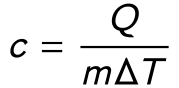
The formula for specific heat looks like this:
c = Q / (mΔT) Q is the amount of supplied or subtracted rut (in joules), m is the mass of the sample, and ΔT is the deviation between the initial and final temperatures. Oestrus capacity is measured in J/(kg·M).
Typical values of specific heat
You lot don't need to use the oestrus capacity calculator for near mutual substances. The values of specific estrus for some of the nearly pop ones are listed below.
- water ice:
2,100 J/(kg·K) - h2o:
4,200 J/(kg·K) - h2o vapor:
2,000 J/(kg·K) - basalt:
840 J/(kg·K) - granite:
790 J/(kg·Grand) - aluminum:
890 J/(kg·Grand) - atomic number 26:
450 J/(kg·K) - copper:
380 J/(kg·K) - lead:
130 J/(kg·Grand)
Having this information, yous tin too summate how much energy you need to supply to a sample to increase or subtract its temperature. For example, you can check how much rut y'all need to bring a pot of h2o to the boil to cook some pasta.
Wondering what the outcome really means? Try our potential energy computer to check how high you would raise the sample with this corporeality of energy. Or bank check how fast could the sample movement with this kinetic energy calculator.
FAQ
How to calculate specific heat capacity?
- Find the initial and final temperature as well as the mass of the sample and energy supplied.
- Subtract the final and initial temperature to get the alter in temperature (ΔT).
- Multiply the change in temperature with the mass of the sample.
- Divide the heat supplied/energy with the product.
- The formula is
C = Q / (ΔT ⨉ grand).
What is specific heat chapters at constant volume?
The specific heat capacity is the heat or energy required to change i unit of measurement mass of a substance of a constant volume by i °C. The formula is Cv = Q / (ΔT ⨉ m).
What is the formula for specific heat?
The formula for specific estrus capacity, C, of a substance with mass m, is C = Q /(thousand ⨉ ΔT). Where Q is the energy added and ΔT is the change in temperature. The specific heat chapters during unlike processes, such as constant book, Cv and abiding pressure level, Cp, are related to each other past the specific heat ratio, ɣ= Cp/Cv, or the gas constant R = Cp - Cv.
What are the units for specific oestrus chapters?
Specific heat capacity is measured in J/kg K or J/kg C, every bit information technology is the heat or energy required during a constant volume procedure to change the temperature of a substance of unit mass by i °C or i °K.
What is the specific heat chapters value of water?
The specific heat of h2o is 4179 J/kg Thou, the amount of heat required to raise the temperature of 1 thou of h2o by ane Kelvin.
What are the imperial units for specific estrus?
Specific heat is measured in BTU / lb °F in imperial units and in J/kg K in SI units.
What is the specific heat capacity value of copper?
The specific estrus of copper is 385 J/kg K. You can use this value to judge the free energy required to rut a 100 g of copper past 5 °C, i.e., Q = thou x Cp x ΔT = 0.1 * 385 * 5 = 192.5 J.
What is the specific rut chapters value of aluminum?
The specific heat of aluminum is 897 J/kg K. This value is almost 2.iii times of the specific estrus of copper. Y'all tin can use this value to gauge the energy required to heat a 500 k of aluminum by v °C, i.e., Q = m x Cp ten ΔT = 0.5 * 897* 5 = 2242.five J.
Change of temperature (ΔT)
Specific estrus capacity (c)
We made a video that explains thermodynamics concepts on the instance of cooling drinks! Sentinel it here:

mitchelleatentsen.blogspot.com
Source: https://www.omnicalculator.com/physics/specific-heat

Post a Comment for "Show One Sample Calculation to Find the Tf for a 52.0% Mass Solution (Again"